AI TOOL / #01420
mcp server
A directory for discovering and sharing Model Context Protocol (MCP) servers.
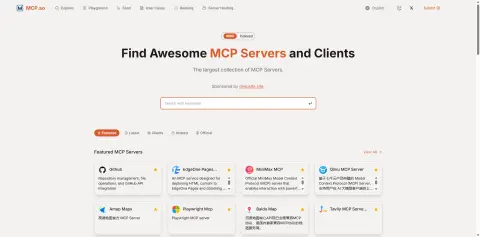
Introduction
A directory for discovering and sharing Model Context Protocol (MCP) Servers.
What are MCP Servers?
An MCP server is a platform designed to collect and organize Model Context Protocol (MCP) servers. Functioning as a central directory, it enables users to discover, share, and learn about various MCP servers that can be utilized in artificial intelligence applications. Through a client-server architecture, MCP servers enhance the capabilities of AI systems, allowing intelligent platforms like Claude to securely connect to various data sources and provide access to external data, tools, and informational resources.
How to use MCP Servers?
Users can search for and discover MCP servers on the mcp.so website. There, they can browse a selection of the best, most recent, officially recognized, and innovative MCP servers. To submit a new server, users can create a new issue in the GitHub repository, providing detailed information regarding the server’s name, description, features, and connection details.
The core functions of MCP Servers
A collection of MCP servers
Search and discovery of MCP servers
MCP Client Directory
A community platform for sharing and learning about MCP servers
Related
Aistro
An AI-based astrology app that provides personalized horoscope readings and insights.
moveme.tv
AI-powered movie recommendatio...
Scholar AI
AI-powered research and learning tools, providing access to over 200 million academic papers.
PriceIntelGuru
An AI-powered price intelligence and product matching platform.
lineup.ai
Artificial intelligence-driven prediction and scheduling software designed for the catering industry, aimed at optimizing operations and enhancing profitability.
SQL Notes
Datascale: Enables organizations to query and visualize data relationships, while automating the management of data catalogs.